The European Accessibility Act (EAA) is now part of Irish law, and many business owners are asking the same question: does it apply to my website? This guide explains, in plain English, which websites are covered, who is exempt, what the rules ask for and what to do next.
Short answer: since 28 June 2025, online shops and other covered services that sell to consumers in Ireland must be accessible to people with disabilities. Very small businesses providing services are exempt, and a simple brochure website is not one of the services listed in the Act. If you sell online and you are not a microenterprise, you should act now.
What is the European Accessibility Act?
The European Accessibility Act is an EU directive (Directive (EU) 2019/882) that sets common accessibility rules for certain products and services across the EU. Ireland implemented it through S.I. No. 636 of 2023, the European Union (Accessibility Requirements of Products and Services) Regulations 2023. According to the Competition and Consumer Protection Commission (CCPC), the rules have applied in Ireland since 28 June 2025.
The aim is simple: people with disabilities, and older people, should be able to use everyday products and services, including buying online, without barriers.
Which websites does the EAA cover?
The Act covers specific consumer services, not every website. The ones most relevant to Irish businesses are:
- E-commerce services: websites and apps where consumers buy products or services online, such as online shops and marketplaces;
- consumer banking services;
- e-books and the software used to read them;
- websites, apps and e-tickets for passenger transport services;
- electronic communications services and services that give access to audiovisual media.
The Government of Ireland’s guidance explains that websites and mobile apps are not “products” under the Act. They are covered as part of a service, for example the online shop through which you sell.
In practice, if a consumer can choose something on your website, add it to a basket and pay, your website is very likely an e-commerce service. A website that only presents your business and invites people to call or send an enquiry is not one of the listed services, although accessibility is still good practice for every website.
Is my small business exempt?
Possibly. The CCPC’s guidelines for microenterprises confirm that the requirements of the EAA do not apply to microenterprises providing services. A microenterprise is a business that:
- employs fewer than 10 people, and
- has an annual turnover or an annual balance sheet total of no more than €2 million.
Three points are worth knowing:
- the exemption is for services only, so a microenterprise that makes or sells covered products (for example, e-readers or payment terminals) still has obligations;
- the Act applies to services for consumers, so a shop that only sells to other businesses is generally outside its scope;
- businesses grow, so check your numbers each year. An exempt shop today may be covered after a few new hires.
Even if you are exempt, an accessible website is easier for everyone to use, and it often converts better on mobile.
What does an accessible website need?
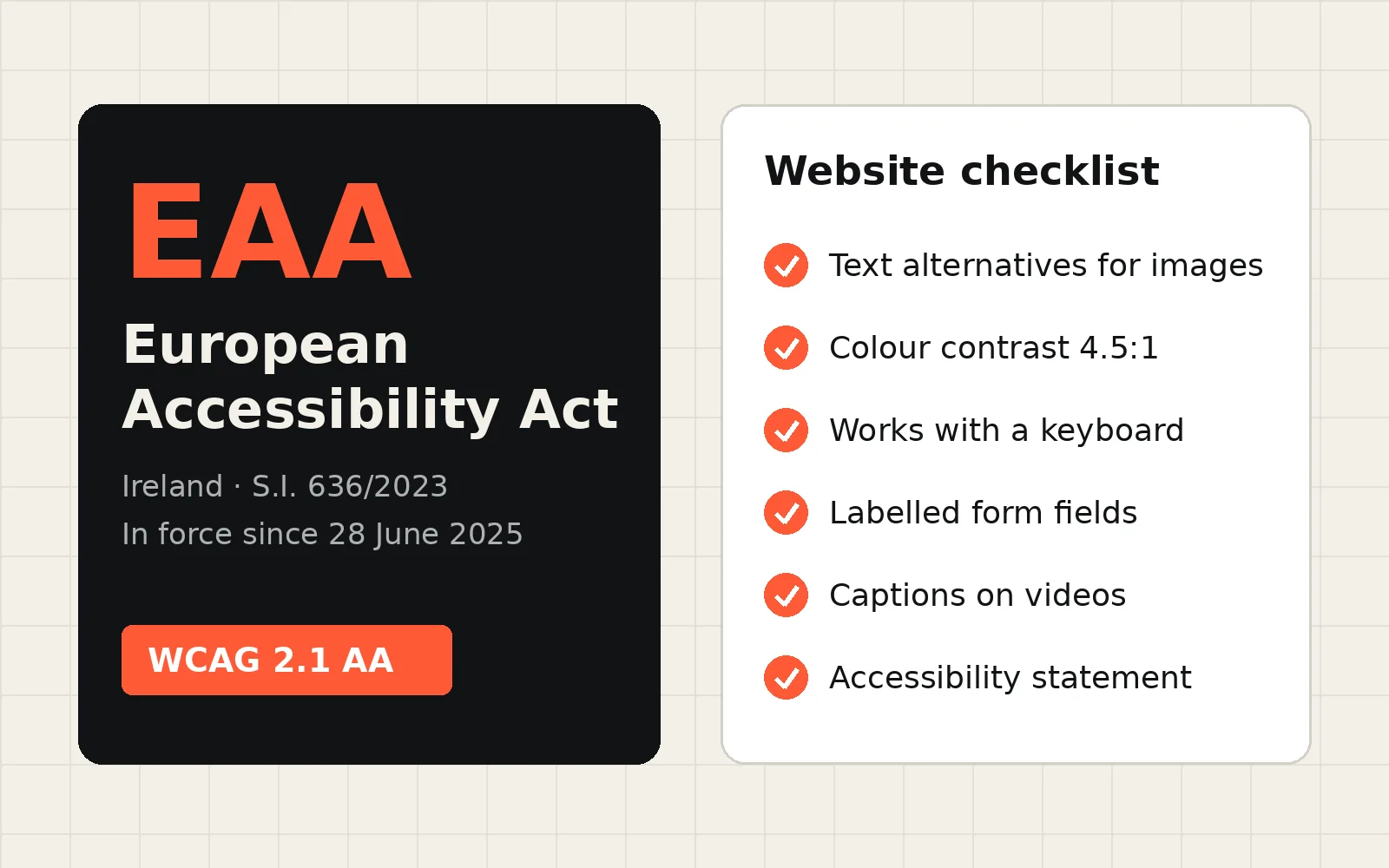
The Act describes accessibility requirements rather than one checklist. In practice, websites are measured against the European standard EN 301 549, whose web requirements follow the Web Content Accessibility Guidelines (WCAG) 2.1, level AA. Typical things to get right are:
- Text alternatives (alt text) for meaningful images, including product photos;
- enough colour contrast: at least 4.5:1 for normal text against its background;
- full keyboard use: menus, filters, the basket and checkout must work without a mouse, with a visible focus outline;
- clear labels and error messages on forms, so people know what to type and what went wrong;
- captions for videos with speech;
- text that can be enlarged to 200% without breaking the layout;
- a sensible page structure with real headings and descriptive link text, so screen reader users can find their way.
Service providers must also publish information explaining how their service meets the accessibility requirements. The CCPC’s guidance on business obligations says this information must itself be accessible and kept for as long as the service operates. On a website, this is usually an accessibility statement page.
New in September 2026: EN 301 549 moves to WCAG 2.2
On 2 September 2026, a new version of the standard, EN 301 549 V4.1.1, was published. As the National Disability Authority and AccessibleEU explain, it updates the web requirements from WCAG 2.1 to WCAG 2.2 level AA. It becomes the official reference only once the European Commission cites it in the Official Journal of the EU, and the NDA notes that there is no immediate compliance deadline attached to it. Until then, WCAG 2.1 AA remains the reference, but a new website should be built with WCAG 2.2 in mind.
Who enforces the EAA in Ireland, and what are the penalties?
Ireland shares enforcement between several regulators. The CCPC is responsible for e-commerce services and e-books, while other bodies cover areas such as electronic communications and transport.
Under Regulation 32 of S.I. 636/2023, breaking the rules is an offence. On summary conviction, the penalty is a class A fine (up to €5,000) and/or up to 6 months in prison. On conviction on indictment, it is a fine of up to €60,000 and/or up to 18 months in prison. Company directors and managers can also be held personally responsible in some cases.
Is there a grace period until 2030?
You may read that businesses have until 2030. That is only partly true. The transitional period that ends on 28 June 2030 lets service providers keep using products they already used before 28 June 2025, such as existing terminals, and lets service contracts agreed before that date run until they end, for no more than five years. Websites are not products under the Act, so do not treat 2030 as a general deadline for your online shop. If you are unsure, take legal advice.
How to get your website ready
- Check whether you are covered. Do you sell to consumers online? Are you above the microenterprise limits?
- Audit the key pages. Start with the home page, product or service pages, the basket, checkout, contact forms and booking flow. Combine automated tools with a manual test using only a keyboard.
- Fix the common issues first. Missing alt text, low contrast, unlabelled form fields and checkouts that trap keyboard users cause most problems.
- Check third-party tools. Payment pages, booking widgets, chat and cookie banners are part of your service too. Ask your providers about accessibility.
- Publish an accessibility statement describing how your service meets the requirements and how customers can contact you if they have a problem.
- Keep it accessible. Train whoever adds products or blog posts to write alt text and use proper headings, and re-test after major changes.
Be careful with “one-click” accessibility overlay widgets. They do not replace fixing the website itself, and they cannot make an inaccessible checkout usable on their own.
Need help with an accessible website?
Accessibility works best when it is built in from the start: clear design, good contrast, real headings and forms that everyone can complete. These are the same principles behind good UX/UI web design and responsive websites. If you run an online shop, our guide to e-commerce website design and our e-commerce website development service explain how we build stores for Irish businesses.
If you would like us to review your website or plan a new one, contact Premium Web Design or call us on +353 83 819 9935. We will give you a clear, written quote and an honest view of what your website needs.
This article is general information, not legal advice. It reflects the information published by the CCPC, gov.ie, the National Disability Authority, AccessibleEU and the Irish Statute Book as of 25 October 2026. Always check the current guidance or take legal advice for your own business.