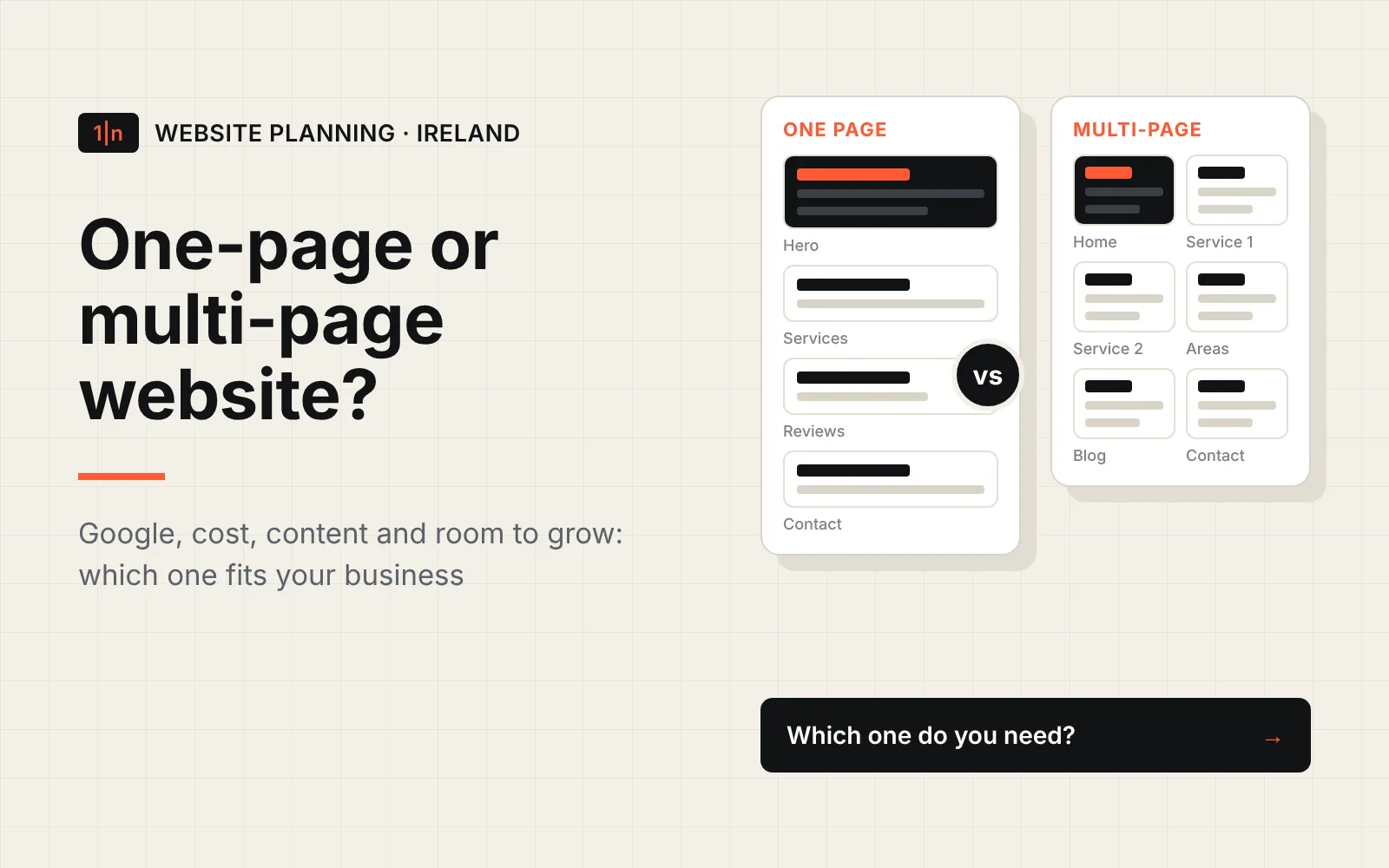
When a small business asks us for a website, one of the first decisions is simple to ask and harder to answer: should it be one page or several? A one-page website puts everything on a single, scrolling page. A multi-page website gives each topic its own page, such as Home, About, Services and Contact. Both can look professional and both can bring enquiries. The right choice depends on what your business sells, where your customers find you and how you plan to grow.
Short answer: a one-page website is enough if you offer one main service in one area and most customers find you through Google Maps, word of mouth or social media. Choose a multi-page website if you offer several services, want to be found in more than one town or county, or plan to add a blog, a portfolio or a shop.
What is a one-page website?
A one-page website is a single long page split into sections. The menu at the top does not open new pages; it scrolls the visitor down to the right section. A typical one-page website for an Irish small business has:
- A hero section with what you do, where you work and buttons to call, WhatsApp or request a quote
- Services in short blocks
- About, with your photo or your team, so people know who they are dealing with
- A gallery of your work, premises or products
- Reviews from your customers
- Frequently asked questions
- Contact: a form, phone, email, opening hours and a map
Because everything is in one place, the visitor reads your story from top to bottom and reaches the contact section without having to look for it.
What is a multi-page website?
A multi-page website has a separate page, with its own web address, for each important topic. A tradesperson might have a page for each service, a clinic a page for each treatment, and a business serving several towns a page for each area. On top of that you can add a blog, case studies, a team page or an online shop.
One-page vs multi-page at a glance
| One-page website | Multi-page website | |
|---|---|---|
| Best for | One main service, one area, a launch or event | Several services, several areas, growing businesses |
| Can rank for your main service and your business name | Each page can rank for its own service or town | |
| Cost | Lower: less design and content | Higher: every page is planned, designed and written |
| Time to launch | Faster | Longer, mostly because of the content |
| Content you need | A few paragraphs and good photos | Text for every page |
| Room to grow | Limited on the page itself, but it can be extended | Easy to add pages, a blog or a shop |
Can a one-page website rank on Google?
Yes, but there is a limit. Google ranks pages, not whole websites, and each page has one title and one description in the search results. A one-page website can rank well for your business name and for one main search, such as “electrician in Swords” or “dog groomer Naas”, especially when it is linked to a well-kept Google Business Profile with reviews.
What a single page cannot do well is target many different searches at once. If you want to be found for “kitchen fitting”, “bathroom renovation” and “attic conversion” in three different counties, each of those deserves its own page with its own title, text and photos. Sections on one page do not get their own place in the search results the way separate pages do.
Whichever you choose, the basics still matter: a clear title and description, business schema, an XML sitemap, Google Search Console, fast loading on phones and real text instead of text inside images. We cover more of this in our guide to writing website content that ranks.
When a one-page website is the right choice
- You are just starting out and need a professional website quickly, without writing ten pages of text.
- You offer one main service, such as a sole trader, a tradesperson or a mobile service.
- Most customers find you locally, through Google Maps, recommendations or social media, and visit your website to check you are real and to get in touch.
- You are promoting one thing: a launch, an event, a single product or a seasonal offer.
- You only have a Facebook or Instagram page and want your own website that you control.
When you need a multi-page website
- You offer several services and want people searching for each one to find you.
- You work in several towns or counties and want to show up in each area.
- You have a lot of content: menus, price lists, treatments, a team, projects or case studies.
- You want to publish articles to answer customer questions and bring in visitors over time.
- You sell online. An online shop always needs product, cart, checkout and policy pages.
How much does each cost?
Prices vary a lot between agencies, so always compare what is included rather than the headline number. As a guide, our own prices start from €890 + VAT for a one-page website and from €1,190 + VAT for a multi-page website with up to five pages. You can see what each package includes on our pricing page, and our guide to how much a website costs in Ireland explains the yearly running costs and how VAT works on a quote.
Remember that the build is not the only cost. Every website, one page or fifty, needs a domain, hosting and regular updates to stay fast and secure.
Can you start with one page and grow later?
Yes, and for many new businesses this is the smartest route. If the one-page website is built on a proper platform such as WordPress, the sections can later become full pages: each service gets its own page, and a blog or a portfolio can be added without starting again. Ask any web designer this question before you sign. Some cheap one-page sites are built in a way that has to be thrown away when the business grows.
Questions to ask before you decide
- How many different services do I want customers to find me for on Google?
- Do I want to be found in one area or several?
- Do I have the time, or the budget, for the text of several pages?
- Will I want a blog, a portfolio or an online shop in the next year or two?
- Can the website grow without being rebuilt?
If you answered “one”, “one”, “not really”, “no” and “yes”, a one-page website is likely a good fit. If not, a multi-page website will serve you better.
Not sure which one you need?
Tell us about your business and we will tell you honestly which option fits, with a fixed written quote. We are a web design studio in Dublin working with businesses across Ireland. Get in touch and we will come back to you with a clear plan and price.