“How much does a website cost?” is the first question almost every business owner asks us, and it is a fair one. The honest answer is that it depends on what the website has to do. This guide explains, in plain English, what Irish businesses typically pay in 2026, what you pay for after launch, how VAT works on a quote and how to compare quotes without getting caught out.
Short answer: for most small Irish businesses, a professionally designed website with a handful of pages typically costs a few thousand euro to build, an online shop costs more, and you should also budget each year for the domain, hosting and maintenance. A cheap quote is not always cheap once the running costs and extras are added in.
Typical website costs in Ireland in 2026
There is no official price list for websites, so the ranges below are a rough guide based on the quotes we see in the Irish market. They exclude VAT and assume you supply the text and photos.
- Do-it-yourself website builder: a monthly subscription, plus a lot of your own time. Good for testing an idea, but you do the design, writing and SEO yourself.
- Template website from a freelancer: roughly €800 to €2,000. A ready-made theme with your logo, colours and content added.
- Custom-designed business website (5 to 10 pages): roughly €1,500 to €4,000. Designed around your business, with mobile layouts, contact forms, basic SEO and training.
- Online shop (e-commerce): roughly €3,000 to €10,000 or more, depending on the number of products, payment and delivery options and links to stock or accounting systems.
- Bespoke websites and web apps: from around €10,000, for booking systems, customer portals, member areas and other custom features.
Treat these numbers as a starting point for your budget, not a quote. Two websites with the same number of pages can be very different jobs.
What affects the price of a website?
1. Design: template or custom
A template saves design time, but your website will look like many others and may carry code you do not need. A custom design is planned around your customers and your brand, which usually means a clearer message and more enquiries. Good design also follows the UX/UI principles that make a website easy to use.
2. Number of pages and who writes them
Every page needs planning, design and content. Writing is often the part that delays a project. If you want the agency to write the text, or to write a separate page for each service and location for SEO, expect that to be priced separately. Content that ranks on Google takes work, as we explain in our guide to writing website content that ranks.
3. Features
Contact forms and a Google map are standard. Online booking, quote calculators, multiple languages, member logins, integrations with your CRM or accounting software and anything custom-built add time and cost.
4. Online shop or not
E-commerce is a bigger job: product pages, categories, payments, delivery rules, emails, stock, terms and conditions and testing the full checkout. If you sell online to consumers, your shop may also need to meet the European Accessibility Act, which should be planned in from the start. See our guide to e-commerce website design for what a good store needs.
5. Photos, video and branding
Professional photography and a logo or brand refresh are separate costs if you need them. Good, original photos usually make a bigger difference than any design trick.
6. Speed, security and SEO foundations
A fast, secure website with clean code, proper headings, page titles and descriptions is easier to find on Google. Some cheaper quotes leave this out, and fixing it later costs more than doing it right first time.
Running costs after launch
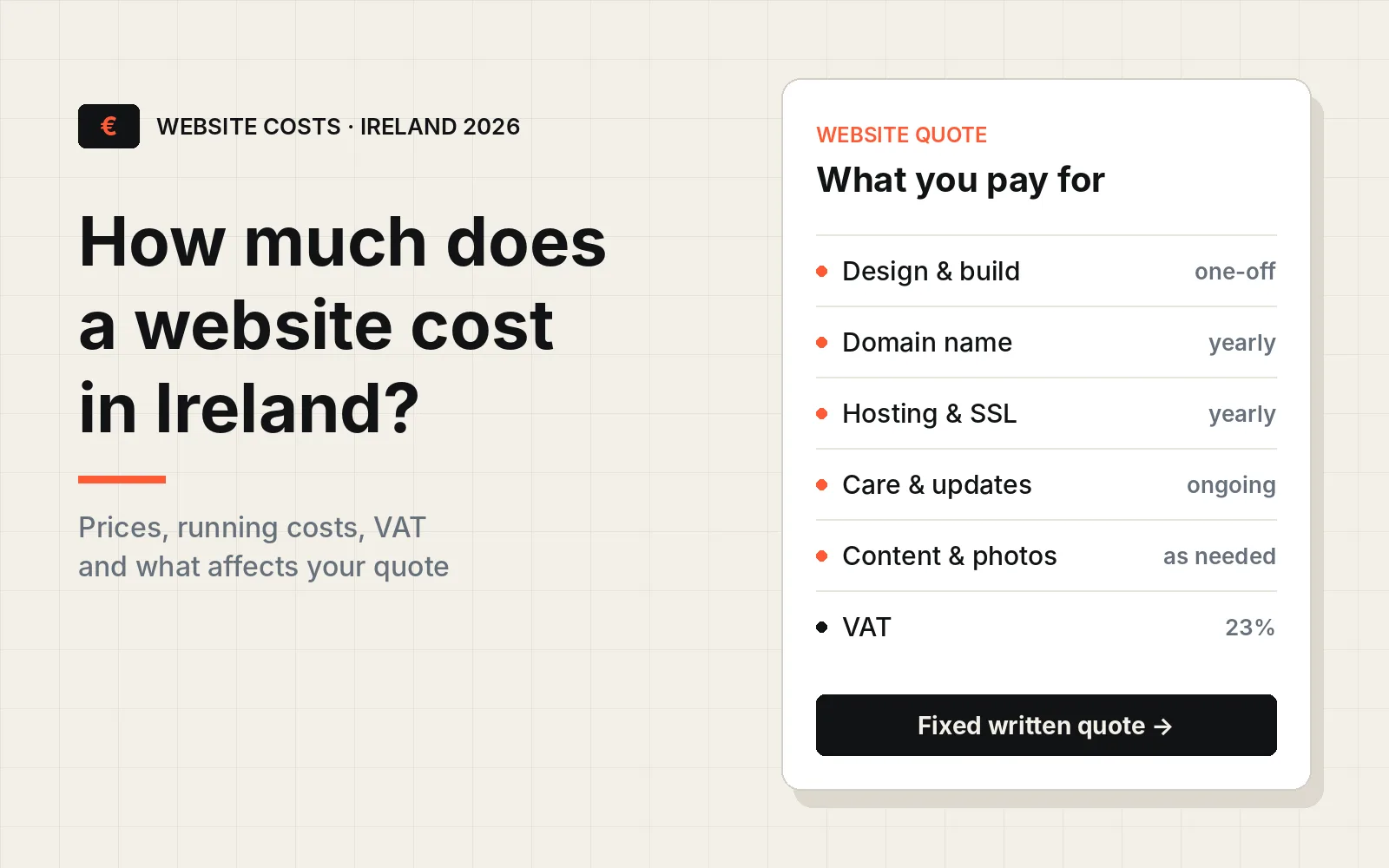
The build is a one-off cost, but every website has running costs too. Ask for them in writing before you agree to a quote:
- Domain name (for example, yourbusiness.ie): renewed every year.
- Hosting and SSL certificate: where your website lives, paid monthly or yearly. Fast, reliable hosting in Europe is worth paying a little more for. See our web hosting service.
- Maintenance: updates to WordPress, the theme and plugins, backups, security checks and uptime monitoring. A neglected website is a security risk, as we explain in our WordPress security guide.
- Changes and new content: new pages, offers, photos and blog posts, either included in a care plan or charged when needed.
- Paid tools: some websites need premium plugins, booking software or email marketing subscriptions.
A useful way to compare quotes is the three-year cost: the build price plus three years of domain, hosting and maintenance.
VAT on website quotes in Ireland
Website design is generally charged at the standard VAT rate, which is 23% according to Revenue’s current VAT rates. Always check whether a price is quoted with or without VAT, because on a €3,000 website the difference is €690.
Not every web designer charges VAT. A business that supplies only services must register for VAT once its turnover goes above €42,500 a year, the threshold that has applied since 1 January 2025 (see Revenue: who should register for VAT). A smaller freelancer may therefore quote without VAT. If your own business is VAT registered, you can usually reclaim VAT charged on a website used for your business, so ask your accountant how a quote with VAT affects you.
Are there grants for a new website in 2026?
Less than there used to be. The well-known Trading Online Voucher closed in December 2024, as we explain in our article Trading Online Voucher Ireland: Is It Still Available in 2026?
Its replacement, the Grow Digital Voucher, is run by the Local Enterprise Offices. It offers 50% of eligible costs, with grant aid from €500 up to €5,000, and you must first complete the free Digital for Business programme. However, the Local Enterprise Office guidance says it is aimed at new business software subscriptions and that it does not support bespoke website development. Do not plan your website budget around a grant without speaking to your Local Enterprise Office first, and never start spending before you have an approval, because costs incurred before applying are not eligible.
How to compare website quotes
- Ask for a fixed, written quote that lists the pages, features and what is not included.
- Check who owns the website and the domain. The domain should be registered in your business name, and you should be able to move the website if you ever need to.
- Ask about running costs for hosting, maintenance and changes, and compare the three-year cost.
- Ask who writes the content and who supplies the photos.
- Check that SEO basics are included: page titles, descriptions, headings, fast loading, a sitemap and redirects from any old pages.
- Look at real websites the designer has built that are still live, and read their Google reviews.
- Agree the timeline. Most delays come from content, so ask when the clock starts.
How we price websites at Premium Web Design
We do not publish a price list, because every business needs something different. After a short conversation about your goals, we send a fixed written quote, so you know the full cost before we start. Most websites are delivered within 3 to 6 weeks after the content is approved. Florin designs and builds every website himself, and we meet clients in Dublin if they prefer, or talk by phone, video or WhatsApp.
Whether you need a WordPress website, an online shop, a redesign or ongoing website maintenance, contact Premium Web Design or call us on +353 83 819 9935 for a free, no-obligation quote.
The price ranges in this article are a general guide, not a quote. VAT and grant information reflects what Revenue and the Local Enterprise Offices publish as of 2 November 2026. Rules can change, so always check the current guidance or ask your accountant.