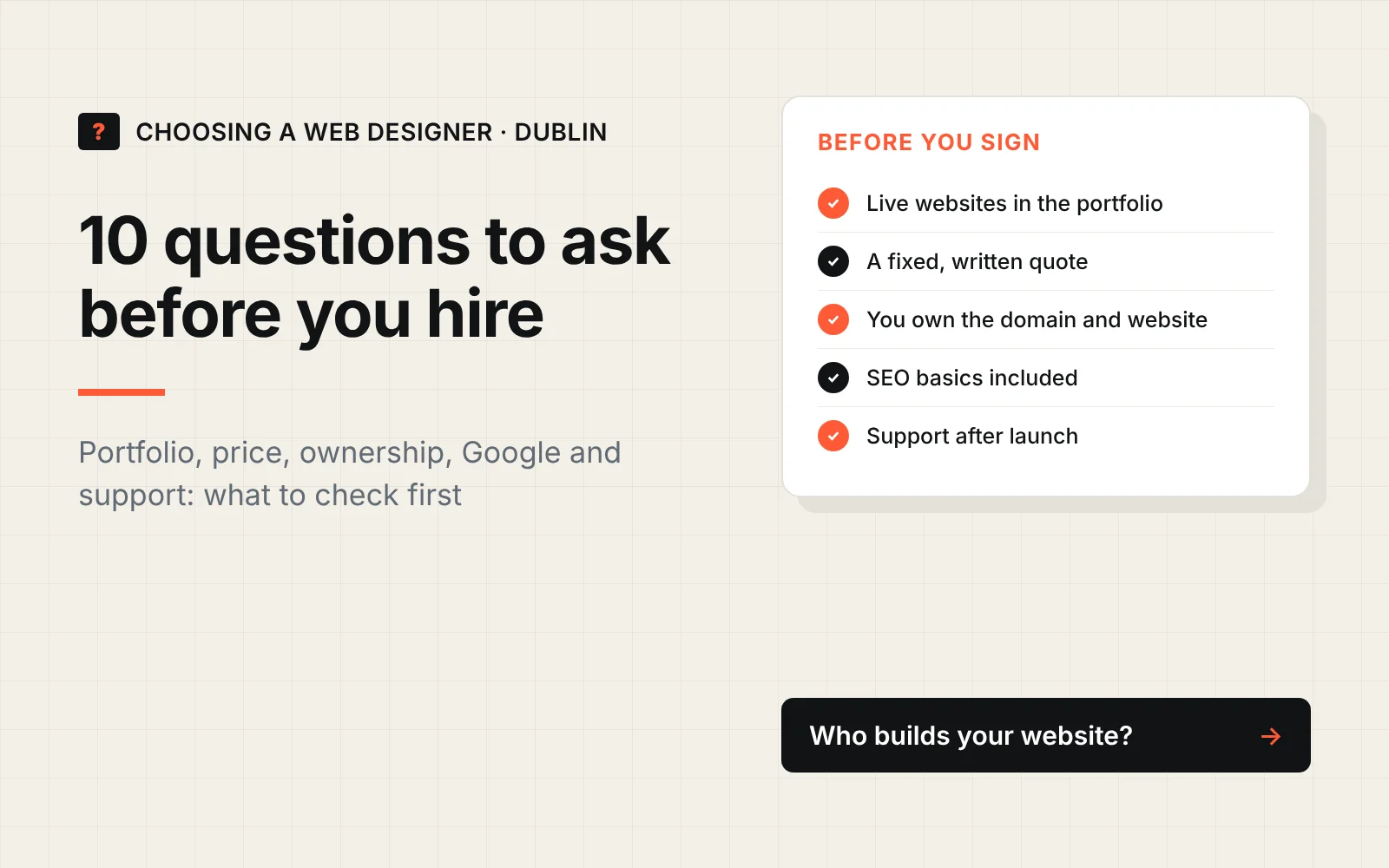
Choosing a web designer is one of those decisions that looks simple until you start comparing quotes. One studio asks €900, another €4,000, a freelancer on social media offers to do it for less, and every website in every portfolio looks good in a screenshot. The real differences only show up later: who owns the website, whether it brings enquiries from Google, and who picks up the phone when something breaks.
We are a web design studio in Dublin, and these are the questions we would ask if we were on your side of the table. Use them with any designer you are considering, including us.
1. Can I see websites you have built that are still live?
Screenshots and mock-ups prove that someone can design a nice picture. Live websites prove that they can build something that works. Open a few of them on your phone, try the menu and the contact form, and check how quickly the pages load. If you can, look for websites from businesses similar to yours, and ask whether you could speak to one of those clients.
2. Who will actually design and build my website?
Some agencies sell the project and pass the work to a subcontractor or an overseas team. That is not always bad, but you should know who is doing the work and who you will be talking to. With a small studio, the person you meet is often the person who designs your website, which makes changes faster and avoids things being lost between people.
3. Is the quote fixed and in writing?
A good quote lists what you get and what it costs, before any work starts. Ask whether the price is fixed or an estimate, whether VAT is included, what happens if you need an extra page later, and how payments are split. “From” prices are a useful guide, but the written quote is what counts. Our guide to how much a website costs in Ireland explains the typical ranges and the yearly running costs.
4. What exactly is included?
Two quotes with the same price can cover very different work. Check the list for:
- The number of pages and what each one is for
- The text: do you write it, or does the designer help with it?
- Photos: your own, stock images, or a photographer?
- Contact forms, booking, maps and click-to-call buttons
- Basic SEO set up at launch (see question 7)
- Hosting, domain and email, or whether those are separate
- How many rounds of changes are included in the design
5. Who will own the domain and the website?
This is the question most people forget, and the one that causes the most trouble later. Your domain name should be registered in your name or your business’s name, and you should have access to it. Ask what happens if you decide to move to another designer or host: can you take the website with you, or is it built on a system that only the agency can run? A website you cannot move is a website you are renting.
6. Will it work well on phones and load quickly?
Most visitors to a local business website arrive on a phone, often from Google Maps or social media. Ask how the designer tests mobile layouts and page speed. You can check any of their live websites yourself with Google’s free PageSpeed Insights tool. A slow, heavy website loses visitors before they see what you offer, and we cover the design side of this in our guide to responsive web design.
7. What SEO is included at launch?
“SEO” can mean anything from ticking a box in a plugin to months of ongoing work. At launch, every business website should at least have:
- A clear title and description for each page
- Real text on the page, not text inside images
- An XML sitemap and the site connected to Google Search Console
- Business details in schema markup, matching your Google Business Profile
- Redirects from the old website’s pages, if you are replacing one
Ongoing SEO, such as new content and building links, is a separate service. Ask what is included now and what would cost extra. Our article on writing website content that ranks explains why the text matters as much as the code.
8. How will you handle cookies, privacy and accessibility?
If your website uses analytics, advertising pixels or embedded videos and maps, the Data Protection Commission’s guidance on cookies says you generally need the visitor’s consent first, with “accept” and “reject” given equal prominence. Ask how the designer sets up the cookie banner and whether non-essential tools really wait for consent. Ask too how they approach accessibility: readable text, good contrast and forms that work with a keyboard. Our guide to the European Accessibility Act in Ireland explains who the new rules apply to.
9. What happens after the website goes live?
A website is not finished on launch day. WordPress, its theme and its plugins need regular updates to stay secure, and someone needs to take backups and fix things if they break. Ask:
- Who updates the website, and how often?
- Are there backups, and has anyone tested restoring one?
- If I need a change, who do I contact and how quickly will it be done?
- What does this cost per year?
Our WordPress security guide covers what good ongoing care looks like.
10. How long will it take, and what do you need from me?
Ask for a realistic timeline and what it depends on. In our experience, the design and build are rarely what slows a project down: waiting for text, photos and feedback is. A good designer will tell you up front what they need from you and when, and will help you with the parts you find hard, such as writing about your own business.
Red flags to watch for
- No live examples, only screenshots or templates
- A price with no written list of what is included
- The domain registered in the designer’s name with no plan to transfer it to you
- Guaranteed first place on Google: nobody can promise that
- No answer about updates and support after launch
- Pressure to sign today to keep a discount
How we answer these questions
Premium Web Design was founded in 2019 by Florin Patrascu. We are a small studio: Florin designs and builds every website himself, so the person you talk to is the person doing the work. We can meet you in Dublin if you prefer, or talk by phone, video call or WhatsApp.
Our portfolio only shows websites that are still live, and every project starts with a fixed, written quote. You can see our starting prices on the pricing page. Our websites run on our own theme and plugins for SEO, forms, security and cookie consent, which we keep up to date ourselves. Most clients prefer not to edit their website themselves, so we make the changes for them as part of our website maintenance.
Ready to compare?
Ask us the same ten questions. Tell us about your business and we will come back with honest answers, a clear plan and a fixed price. We are a web design studio in Dublin working with businesses across Ireland. Get in touch.